

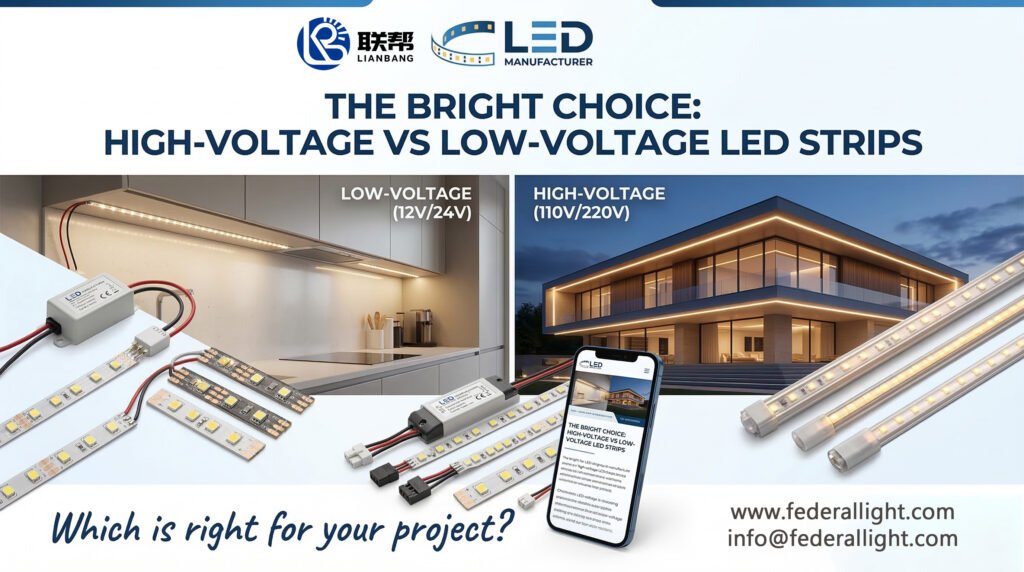
In the world of modern lighting, LED strip lights have revolutionized how we approach both aesthetic and functional illumination. However, for contractors, architects, and interior designers, one of the most critical decisions during the planning phase is choosing between High-Voltage and Low-Voltage systems.
As a dedicated manufacturer (江门联帮照明有限公司 Jiangmen City Federal Lighting Co,. Ltd.) of both configurations, we understand that the “BEST” choice depends entirely on the specific requirements of your installation. Here is a breakdown of the technical differences, advantages, and ideal use cases for each.
Understanding the Technical Divide
The primary difference lies in how the power is managed and delivered to the LEDs.
1. Low-Voltage LED Strips (12V or 24V)
Low-voltage strips require a dedicated LED driver (transformer) to convert standard AC wall power into DC power.
Precision and Dimming: These strips offer superior dimming capabilities and are often more compatible with advanced control systems (DMX, Zigbee, or Bluetooth).
Safety: The lower voltage significantly reduces the risk of electrical shock, making them the standard for indoor, “touchable” areas.
Cutting Increments: Because the voltage is lower, the “cut points” are much closer together (often every 1–2 inches), allowing for high-precision tailoring in tight spaces like cabinetry or shelving.
The Limitation: Voltage drop. Because the power is low, it loses strength over distance. Typically, these runs are limited to 5–10 meters before requiring a new power feed to avoid dimming at the end of the line.
2. High-Voltage LED Strips (110V or 220V)
High-voltage strips plug directly into a standard outlet or are hardwired into the main power line using a simple bridge rectifier.
Long Continuous Runs: This is where high voltage shines. You can run 50 to 100 meters of LED strip from a single power point without any noticeable drop in brightness.
Simplicity: No bulky external drivers are needed. This simplifies the bill of materials and reduces installation time for large-scale projects.
Durability: These strips are usually encased in thick PVC or silicone sleeves to handle the higher voltage safely, making them naturally robust against the elements.
The Limitation: Larger cutting increments (often 0.5 to 1 meter) mean they are less flexible for small, custom-sized gaps.
Comparison at a Glance:
| Feature | Low-Voltage (12V/24V) | High-Voltage (110V/220V) |
| Max Run Length | Short (5–10m) | Very Long (50m+) |
| Safety | High (Low shock risk) | Moderate (Requires careful sealing) |
| Installation | Requires Driver | Direct Plug-in / Hardwire |
| Cutting Precision | High (Every few cm) | Lower (Every 0.5–1m) |
| Best For | Under-cabinets, Accents, DIY | Building Outlines, Large Landscapes |
Which Should You Choose?
Choose Low-Voltage if:
- You are installing lighting in a kitchen, bathroom, or near water.
- You need highly precise lengths for furniture or architectural niches.
- You want professional-grade, flicker-free dimming for a home theater or bedroom.
Choose High-Voltage if:
- You are illuminating the exterior perimeter of a commercial building.
- You have a massive landscape project requiring hundreds of feet of light.
- You want a cost-effective solution that doesn’t require hiding multiple power drivers.
Quality Manufacturing Matters
Regardless of the voltage, the lifespan of your lighting depends on the quality of the PCB (Printed Circuit Board) and the phosphor used in the LED chips. As a manufacturer specializing in both high and low-voltage solutions, we ensure that every meter of light is tested for color consistency and thermal management.
You are welcome to visit our Factory
江门联帮照明有限公司
Jiangmen City Federal Lighting Co,. Ltd.
info@federallight.com